
















The method stays with you
The store order, the check list, the shared base and the review agenda are written so that you can read them, keep them and change them.
Several European stores, one plan
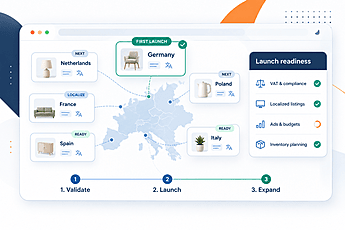
One plan for several European Amazon stores: which store to open first, what to check in each, and the listing, ad and content work that follows.
An Amazon agency in Europe works from one plan across several stores. The plan sets the order in which stores open, checks the obligations in each one, and separates the work that is shared from the work that is done per store. Listings, advertising and content then follow that order, store by store.
 Germany
 France
 Italy
Italy Spain
Spain Netherlands
 Poland
The starting point
Each European Amazon store has its own language, listing rules, tax set-up and advertising interface. A brand that runs each store as a separate project repeats the same catalogue and content work every time, and the stores slowly drift apart in their data and their claims.
A single plan sets three things before any listing is changed. It sets the order in which stores open, the shared base that each store uses, and the checks each store needs before it goes live. The plan comes first because a listing built for one store is not automatically right for the next.
Without a plan, the usual problem is drift. The first store launches with one set of claims, the second with a slightly different set, and the third with a listing that was copied from the second and never checked. Each one looks fine on its own. Together they split the brand's data, its reviews and its search history across several weak listings, and the brand pays for that split later in cleanup work.
This is a method, not a ranking. The page describes how a multi-store plan is built and how to judge any agency that offers one. It does not rank agencies or compare them by name.
Sequence
The order rule is simple. Start where the brand already sells or already holds stock, then add the stores that can use the same catalogue and listing base. Opening a store without a stock plan, a listing base and a check list usually creates work that has to be undone later.
The UK is treated as its own route. It is a separate marketplace, and trade with it runs through its own customs and VAT position after leaving the EU. A brand with a UK plan is better served by the UK agency page, which covers the UK route in detail.
Before the order is set, the plan reads the data the brand already holds. Sales by product, the stock position in each location, returns and reviews, and any listing that already ranks in a store all point to where the first launch will work. A store where the brand has no sales history can still be the right second or third step, but it should not be the first one without a reason written down.
We do not name store sizes or revenue on this page. Store choice is made from the brand's own data, not from a league table of markets.
Per-store checks
Obligations differ by store, and they change over time. Each store gets its own check rather than an assumption carried over from the last one. The table lists five checks that most often hold up a launch. Each row says what to check and where to verify it. None of the rows states a rate, a scheme name or a date. Those come from the store's own help pages on the day of the check.
| Check | Why it matters | Where we verify it | Status |
|---|---|---|---|
| 1. VAT registration | Depends on where stock is held and on sales into the store. | Amazon's VAT help pages for the store | Verify before launch |
| 2. Packaging duties | Packaging obligations are set by country, and each store can differ. | The national register and Amazon's packaging help page | Verify before launch |
| 3. Listing language | Listing copy has to suit the store's language and listing rules. | Amazon Seller Central for the store | Verify before launch |
| 4. Product compliance | Product rules can require checks or markings before a product is sold. | Amazon's compliance pages for the category | Verify before launch |
| 5. Pan-EU offer | A Pan-EU product needs an active offer in each store that Amazon names for it. | Amazon's Pan-EU help page | Verify before launch |
The check list is kept as a working file, not a one-off form. Each row records the date it was checked, the source it was checked against, and the name of the person who signed it off. When a store changes a rule, the row is reopened, and the listings that depend on it are checked again before the change reaches the live pages.
Treat the table as a starting list. The store's own help pages decide each row, and a row is not closed until its source is recorded in the launch file.
Language and localisation
Translation and localisation are different jobs. Translation carries the words into another language. Localisation changes the search terms, the units, the examples and the claims so that they fit the store. A listing can be translated word for word and still fail, because buyers in that store search with different terms.
For the listing copy itself, meaning the title, bullets and description, our listing service covers the work for each store. Translated listing text is a separate route. Ask about it in the listing review, and we will confirm the scope before any text is written.
Search terms are the part most often missed. A term that brings traffic in one store can carry a different meaning in another, or be almost unused there. The keyword work for each store is done from that store's own search data, and the title, bullets and backend terms are written from that work, not from a translated list.
Text inside product images needs its own check. The rules for image text differ by store, so we confirm the current rules for each store before any image text is changed. Images are never changed on the basis of a rule we have not checked.
Advertising and search
Advertising runs per store, in the order set in the sequence step. Each store has its own search data, its own competitors and its own spend, so the campaign structure is built store by store. Shared logic is limited to naming, reporting and the product groups that are the same in each store.
Organic search follows the same pattern. Keywords, titles and backend terms are planned for each store, and only the terms that match across stores are shared. Advertising and organic work reinforce each other. Ads show where the listing's search terms already work, and organic work fills in the terms that ads find but the listing does not yet carry.
The work is described in two service pages: advertising management covers the campaigns, and SEO services covers the organic search work.
How the plan runs
The plan runs in six steps. Each step ends with a named output, and the next step does not begin until that output is on file. The rail below shows the six steps in order.
The stores the brand sells in, or plans to enter, and the stock locations it uses.
Output: store orderVAT, packaging, listing language and product compliance, checked store by store.
Output: check list per storeOne catalogue, one content plan and one set of brand files for each store.
Output: shared baseListings built for each store, in the order from step 1, with the checks cleared first.
Output: live listingsCampaigns and search work set up for each store, using that store's own data.
Output: campaign set-upResults read across stores, and the next store chosen from the data.
Output: next storeThe timeline follows the store map. We do not set a number of weeks until the store list and the checks are known, because both change the order of the work.
A worked case
Take a brand with one catalogue, stock held in one location, and live listings in its first store. It wants to open a second store. The plan does not start with new listings. It starts by reading what the first store already shows, because that data is the most reliable guide to what the second store will need.
Sales, returns, reviews and search terms are read first. The claims that already sell in the first store are listed, so the second store starts from proven copy rather than from a translation of it.
The catalogue, product data and brand files are checked once. The claims list is reviewed for anything the second store treats differently, such as a rule that applies in one market and not in the other.
Listings are built for the second store's language and search terms, the checks are cleared, and advertising starts on a small set of campaigns. The data from those campaigns decides how far the spend grows.
The example shows the method for an Amazon agency in Europe, not a result. Every brand has different stock, different claims and a different first store, so the sequence is set from that brand's own data at the start.
Measurement
Reporting runs from one view. Each store has a row, a shared summary sits above the rows, and a per-store detail page carries the working data behind each row. Measures are named by type: sales, advertising efficiency, organic visibility, account health and listing health.
We set no target figures on this page, because targets depend on the category and on where the brand starts. The first review sets the baseline for each store, and later reviews compare against it.
Reviews run monthly. Each review decides what changes next, and the next store is chosen from the data rather than from a calendar.
A monthly review follows the same agenda each time. It starts with account health and any listing that has changed status, then moves to the shared base, then to each store in the order set at the start. The last item is the decision: keep the current plan, change the order, or open the next store. Each decision is written down with the data behind it, so the next review starts from a record rather than from memory.
Fit
The multi-store plan suits a specific kind of brand. The two lists below show the fit on both sides.
Routing
Someone searching for an amazon agency in Europe may need one of four routes, and each route has its own page. Pick the card that matches the shape of your business. The plan you build on this page carries over if you later move to a single-country route.
One plan, the order of the stores, and the checks in each store.
This pageThe UK has its own marketplace, customs and VAT position, covered in full on the UK page.
UK agency pageCountry detail sits on its own page. The country pages are listed in the next section.
See the country pagesThe guide sets out the store rules before any plan is made.
Guide to selling in EuropeFull account management across channels is a different route. The full-service marketing page covers the account as a whole.
Country pages
Alongside this plan, GrowithAmazon runs country pages for individual European stores. Each page sets out the launch route for that store, so you can read the detail for the store you plan to open first.
 UKUnited KingdomAmazon.co.uk. The full UK agency page, covering advertising, SEO, listings, A+ content, account management, and UK VAT and compliance.Open the UK page
 SESwedenAmazon.se. The launch route for the Swedish store, covering tax set-up, listings, advertising and fulfilment.Open the Sweden page
 BEBelgiumAmazon.com.be. The launch route for the Belgian store, covering tax set-up, listings, advertising and fulfilment.Open the Belgium page
 TRTurkeyAmazon.com.tr. The launch route for the Turkish store, covering tax set-up, listings, advertising and fulfilment.Open the Turkey page
Turkey is included because Amazon runs a store there, so the page follows the store rather than the continent. Each country page sets out its own store rules, so check the page for the store you plan to open.
Choosing a partner
Any agency can say it runs European stores. These eight questions separate a method from a promise. We hold our own work to the same list.
A named lead, and the languages the team works in, stated plainly.
Store-level examples you can verify, not a count of stores.
A written check list per store, with the source recorded for each row.
A clear split, written down before the work starts.
Account access and data ownership stated in the contract.
One view with a row per store, and access that you keep.
A written handover of files, data and listings.
Written sign-off before a listing change goes live.
The list is most useful in a conversation, not as a form. Take the first three questions to the first call, and the last five to the proposal stage. An agency that answers them with specifics, such as named roles, a sample check list and a plain account of who holds the data, is describing a working method. An agency that answers with general claims about reach is describing a sales pitch.
If an agency cannot answer one of these questions, ask again before you sign. This list is not a ranking and does not say which agency to choose.
Why us
We run listings, advertising, content, account management and compliance as one plan. The UK agency page describes the same services for the UK route, so the two pages agree with each other.
The store order, the check list, the shared base and the review agenda are written so that you can read them, keep them and change them.
Accounts, data and files stay with the brand. The handover is set out in writing before any work begins.
A listing that passes in one store is not assumed to pass in the next. Each store gets its own check list and its own sign-off.
We would rather show that method on your own store data than describe it in general terms. Send your store list and one ASIN from each store, and we will return the store order and the first check list.
Questions
An Amazon agency in Europe runs one plan across several European Amazon stores. The plan sets the order in which stores open, checks the obligations in each, and sequences the listing, advertising and content work that follows. A single-country agency works in one store only.
Start where you already sell or hold stock, then add the stores that can use the same catalogue and listings. The order is set from your own sales and stock data before any store is opened.
It can, if the plan covers both. The UK is a separate marketplace with its own customs and VAT position after leaving the EU, so it gets its own check list inside the same plan. The UK agency page covers the UK route in detail.
Yes, as one plan with separate campaigns for each store. Each store has its own search data and spend, so the campaigns are built store by store. Shared naming and reporting keep the work consistent across them.
Timing depends on the category, the stores and the starting position. The plan sets the order and the checks first, and the review after each store shows what the next step should be. We do not give a number of weeks in advance.
Next step
Send us your current store list, the stock locations you use, and one ASIN from each store. We will return the store order, the obligation check list and the first listing review.