

























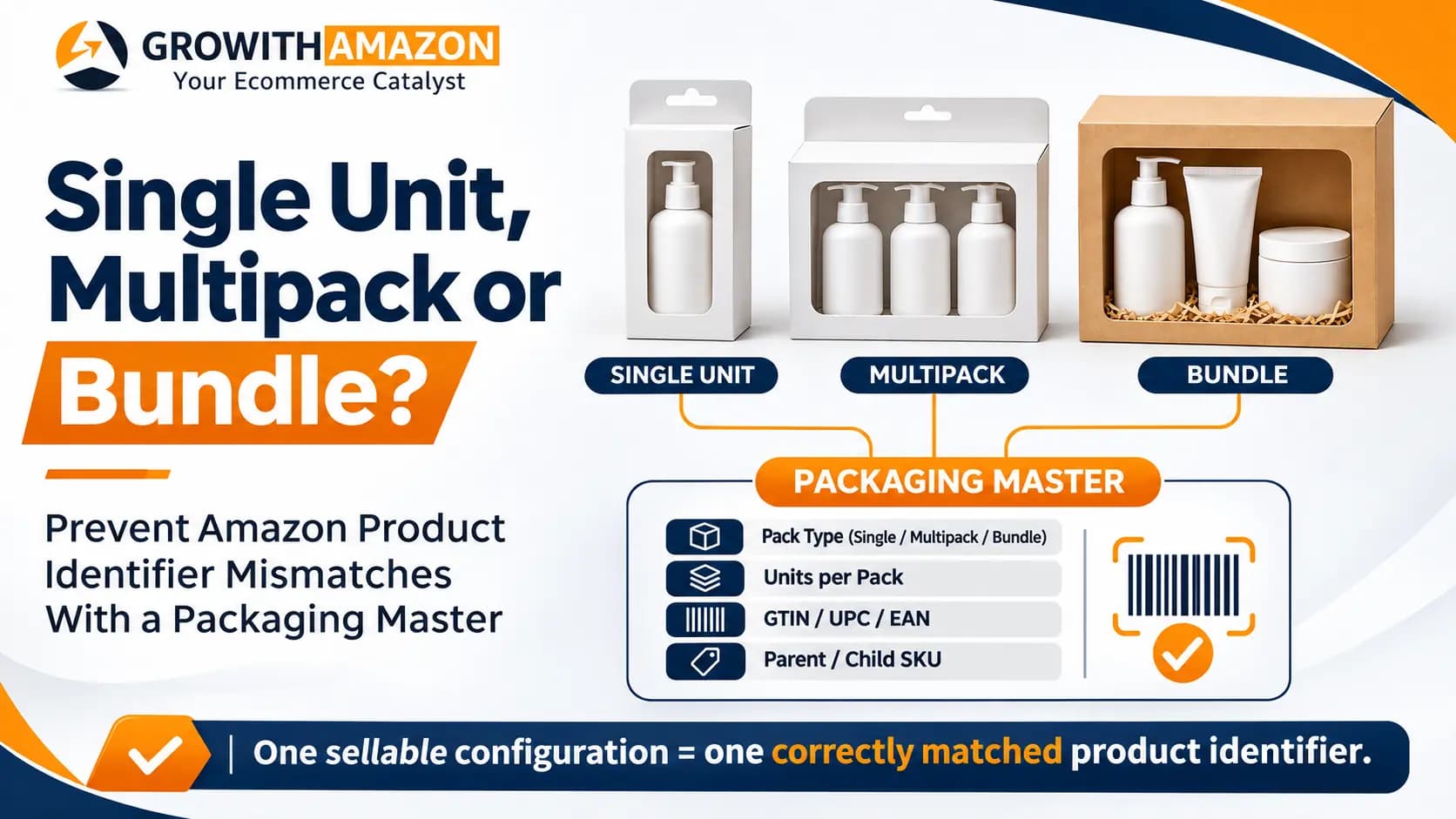
Single Unit, Multipack or Bundle? Prevent Amazon Product Identifier Mismatches With a Packaging Master
An Amazon product identifier mismatch happens when the code, ASIN or listing data that identifies a product does not match what is actually in the box. Most mismatches trace back to one habit: treating a single unit, a multipack and a bundle as if they were the same product. The most reliable fix is a Packaging Master, one reference sheet that records exactly what each sellable item contains and which identifiers belong to it.
An Amazon product identifier mismatch happens when the code, ASIN or listing data that identifies a product does not match what is actually in the box. Most mismatches trace back to one habit: treating a single unit, a multipack and a bundle as if they were the same product. They are not, and each one needs its own clearly documented identity. The most reliable fix is a Packaging Master: one reference sheet that records exactly what each sellable item contains and which identifiers belong to it.
This guide explains the differences between the three formats, how GTINs, UPCs, EANs and ASINs relate, why mismatches happen, and how to build a Packaging Master for your catalog. Where something is an Amazon requirement, we say so. Where it is our recommended practice, we say that too.
Table of Contents
- ●Single Unit vs Multipack vs Bundle: What's the Difference?
- ●How Do UPC, EAN, GTIN and ASIN Work on Amazon?
- ●Why Do Amazon Product Identifier Mismatches Happen?
- ●What Is a Packaging Master and Why Do Sellers Need One?
- ●How to Build a Packaging Master for Your Amazon Catalog
- ●Common Multipack and Bundle Listing Mistakes
- ●Practical Examples of Product Identifier Errors
- ●Amazon Catalog Quality-Control Checklist
- ●Conclusion: Fix the Source, Not Each Listing
- ●Frequently Asked Questions
Single Unit vs Multipack vs Bundle: What's the Difference?
A single unit is one sellable item as the manufacturer packaged it. A multipack is several identical units sold together as one pack. A bundle is two or more different products sold together as one offer. These are working definitions used throughout this article; always check the category-specific rules in Seller Central, because Amazon's handling can differ by category.
| Format | What is inside | Identity question | Typical GTIN source |
|---|---|---|---|
| Single unit | One item | Does the code match the item as manufactured? | Manufacturer or brand owner |
| Multipack | Several identical units | Is the pack a new sellable item with its own count? | The party that creates the pack |
| Bundle | Different items | Who assembled it, and is it physical or virtual? | The party that creates a physical bundle |
The distinction matters because a buyer, a scanner and Amazon's catalog all need to agree on what one "unit" of your listing means. A 6-pack that carries the single unit's code is making a false statement about what it contains.
Need an Amazon expert on your side?
Work with specialists who manage PPC, SEO, catalog, and account health together — so every part of your Amazon business moves in the same direction.
Book a Call TodayHow Do UPC, EAN, GTIN and ASIN Work on Amazon?
A GTIN (Global Trade Item Number) is the umbrella identifier for a trade item. It can be 8, 12, 13 or 14 digits long. A UPC is a 12-digit GTIN used mainly in North America, and an EAN is a 13-digit GTIN used in most other regions. The barcode printed on a package is only the symbol that carries the number; the identifier is the GTIN itself. The final digit of a GTIN is a check digit calculated from the others, not a packaging indicator. GTINs are issued through GS1 or assigned by the manufacturer who owns the product.
Amazon uses its own identifiers on top of this. Its GTIN guide explains how product IDs are used when listing, and the variation guide explains how related products are grouped.
| Identifier | Who assigns it | What it identifies |
|---|---|---|
| GTIN (UPC, EAN, JAN, ISBN) | GS1 or the manufacturer | A specific trade item, worldwide |
| ASIN | Amazon | One product detail page in an Amazon store (10 characters) |
| SKU | You, the seller | Your own inventory record |
| FNSKU | Amazon (FBA) | A specific unit of your inventory in Amazon's warehouse |
The relationship is simple: the GTIN says what the item is, the ASIN is the page Amazon builds around it, and your SKU is your internal handle for it. When the GTIN and the real contents disagree, the ASIN inherits the error.
The GS1 principle that matters most here: a new trade item needs a new GTIN. According to GS1's guidance on multipacks and bundles, a physical bundle you create needs a GTIN from you, a bundle defined by the manufacturer uses the manufacturer's GTIN, and a purely virtual bundle does not need a new GTIN, though each component keeps its own. Amazon's bundling policy points the same way: sellers need a UPC for each bundle they create, and a component's UPC should not be reused for the bundle. Amazon's policy page did not render in our review tools, so confirm the current wording in Seller Central before you rely on it.
Need an Amazon expert on your side?
Work with specialists who manage PPC, SEO, catalog, and account health together — so every part of your Amazon business moves in the same direction.
Book a Call TodayWhy Do Amazon Product Identifier Mismatches Happen?
Mismatches are rarely one dramatic error. They build up from small shortcuts, and these are the common patterns behind identifier errors:
A Single Unit's Code Is Reused on a Multipack
The pack count and the code now disagree, which is the textbook product identifier error on Amazon.
Different Pack Sizes Are Forced Onto One ASIN
If the 3-pack and the 6-pack share a page, one of them is wrong.
A Bundle Borrows a Component's UPC
The component's own listing and the bundle then compete for the same identity.
Supplier Changes Are Not Recorded
The manufacturer changes the pack count or retires a code, and the catalog never hears about it.
Spreadsheets Drift
SKUs, GTINs and titles are edited in different files by different people.
Barcode Symbol and Number Are Confused
A label is reprinted from the wrong file, so the scanned number differs from the listing.
Exemption Assumptions
A GTIN exemption is granted per brand and category, so it should not be assumed to cover every product you add later. If a GS1 code exists for the product, use it.
Need an Amazon expert on your side?
Work with specialists who manage PPC, SEO, catalog, and account health together — so every part of your Amazon business moves in the same direction.
Book a Call TodayWhat Is a Packaging Master and Why Do Sellers Need One?
A Packaging Master is a single, controlled reference table that records what every sellable item physically contains and which identifiers belong to it. It is a working method, not an Amazon requirement or an Amazon term. Its value is simple: every listing, label, purchase order and inventory file is checked against one source instead of against each other.
Without one, the truth about a product lives in several places. The supplier knows the carton count, the listing knows the title, the warehouse knows the label, and nobody holds all three at once. A mismatch is what appears in the gaps.
How to Build a Packaging Master for Your Amazon Catalog
Start with one row per sellable item, not per product. A 1-pack, a 3-pack and a bundle that includes that product are three rows, each with its own identity.
| Field | What to record | Why it matters |
|---|---|---|
| Internal item ID | A stable code you control | Survives SKU and title changes |
| Format | Single, multipack or bundle | Decides which GTIN rules apply |
| Units per sale | Number of items in the sellable pack | Must match title, bullets and images |
| Components | Child items and quantities (bundles) | Prevents borrowed identifiers |
| GTIN and type | UPC, EAN or other, plus who issued it | Proves the code belongs to this exact item |
| Exemption status | If used, the brand and category it covers | Avoids assuming coverage that does not exist |
| ASIN, SKU, FNSKU | Amazon and seller identifiers per marketplace | Links your record to the live catalog |
| Variation role | Parent, child or standalone, plus theme | Keeps families simple and accurate |
| Source and review date | Supplier document and last check | Shows when the data was last confirmed |
Then follow a short process:
Step 1: Export Your Live Catalog
Export from Seller Central and list every SKU with its ASIN and current identifier.
Step 2: Confirm Each Item Physically
Count what is in the sellable unit and compare it to the title.
Step 3: Assign a Format
Give every row a format, and mark which items are components of others.
Step 4: Verify GTIN Ownership
Confirm each code was issued by GS1 or the manufacturer for that exact item, and check the check digit.
Step 5: Resolve Conflicts First
Any pack sharing a single unit's code, or any bundle reusing a component's code, goes to the top of the fix list.
Step 6: Lock It
Name one owner, require changes to go through the Master first, and re-check it when a supplier changes packaging.
If you are planning how to create a multipack listing on Amazon or how to assign UPC codes to multipack products, this table is the place to decide before you open the listing form, not after.
Need an Amazon expert on your side?
Work with specialists who manage PPC, SEO, catalog, and account health together — so every part of your Amazon business moves in the same direction.
Book a Call TodayCommon Multipack and Bundle Listing Mistakes
Changing the Pack Count in the Title Only
The identifier, images and quantity attribute stay behind.
Using Variations to Hide Different Products
Amazon advises keeping variation families simple, so group only items that genuinely vary in a defined theme.
Treating an ASIN as a Product Identity You Own
An ASIN is a catalog page, and a mismatched code can still attach your offer to the wrong one.
Printing Labels From the Wrong File
The scanned barcode then disagrees with the listing.
Assuming a Virtual Bundle Needs No Record
It may not need a new GTIN, but it still needs documented components.
Copying a Competitor's UPC
Codes belong to whoever licensed them. Use your own or the brand owner's.
Need an Amazon expert on your side?
Work with specialists who manage PPC, SEO, catalog, and account health together — so every part of your Amazon business moves in the same direction.
Book a Call TodayPractical Examples of Product Identifier Errors
These are illustrative scenarios, not client case studies. They show how the same logic plays out in a catalog.
Example 1: The 6-Pack With a Single-Unit Code
A brand sells a single bottle and later launches a 6-pack. To save time, the 6-pack is listed with the bottle's UPC. In the Packaging Master, both rows show the same GTIN with different units per sale, which is an immediate conflict. The fix: the party that creates the 6-pack obtains a GTIN for it as a new trade item, then updates the listing and labels.
Example 2: The Physical Bundle
A seller packs a shaker and a protein tub together in one shrink-wrap and lists it using the tub's UPC. The bundle is a new physical item created by the seller, so the Master flags it as a bundle with two components and no GTIN of its own. The fix: obtain a GTIN for the bundle and keep the component codes on their own listings.
Example 3: The Changed Pack Count
A supplier moves a product from 12 to 10 units per case but keeps the same code. If the Master records units per sale and a review date, the change is caught at the next supplier update. If it does not, the listing keeps promising 12.
Example 4: The Overloaded Variation Family
A family mixes 1-pack, 3-pack and a gift set under one size theme. The Master shows the gift set is a bundle with different components, so it leaves the family and becomes its own listing.
Amazon Catalog Quality-Control Checklist
Run this before launching a new multipack or bundle, and again each quarter on your active catalog. These are our recommended checks, not an Amazon-mandated list.
☐ Every sellable item has exactly one row in the Packaging Master. ☐ No two rows with different units per sale share a GTIN. ☐ Every multipack and physical bundle has a GTIN issued for that exact item. ☐ Every bundle row lists its components and quantities. ☐ Title, bullets, images and quantity attribute all state the same pack count. ☐ Labels and barcodes were generated from the Master, not from an older file. ☐ Exemptions are recorded with brand and category, and a GS1 code is used where one exists. ☐ Variation families group only items that differ by the chosen theme. ☐ Supplier documents and review dates are current. ☐ Any Amazon-flagged catalog errors are logged against the right row.
For a wider view of listing health beyond identifiers, see our listing audit checklist for conversion killers and the Amazon UK listing audit checklist.
Need an Amazon expert on your side?
Work with specialists who manage PPC, SEO, catalog, and account health together — so every part of your Amazon business moves in the same direction.
Book a Call TodayConclusion: Fix the Source, Not Each Listing
An Amazon product identifier mismatch looks like a listing problem, but it is almost always a data problem upstream. Once a single unit, a multipack and a bundle each have a documented identity, errors become easy to spot and cheap to fix. A Packaging Master gives your team that one source of truth.
Ready to Build Your Next Amazon Success Story?
If you're facing low sales, rising ACOS, inventory challenges, or declining performance, our Amazon agency can help. Book a free strategy consultation and discover the opportunities that can transform your business.
Frequently Asked Questions
Answers to the most common questions about this topic.
1. What causes an Amazon product identifier mismatch?
2. Does a multipack need its own UPC?
3. Can I reuse a single unit's UPC for a bundle?
4. What is the difference between a GTIN and an ASIN?
5. What is a Packaging Master?
Explore the latest Amazon insights, content, and optimization guides trending with sellers in 2026.
Written by Rahul Bisht
Related Articles
Noon Marketplace
Noon Statement of Account Reconciliation: Bridge Your Opening Balance to the Bank Payout
Amazon SEO
Low-Traffic Amazon Image Tests: Set a Minimum Detectable Effect Before Declaring a Winner
Amazon Strategy